
Two days ago, I visited one of our client’s sites in Orange Island, in Lagos Nigeria. In the process of surveying the neighbourhood, I met a lady who was also building a home for her and her husband within the estate. We got talking and she asked a question that led to a 2 hour long conversation. ‘What does your company do?’ She had done consumer research for major FMCG brands in the UK for over two decades and could relate clearly to the problem when I explained what we do to her. It was the most engaging conversation I have had about the work we do at Fortren & Company.
But the truth is, a significant number of our audience and the property market still do not understand what we do with the level of detail that they can explain back to a two year old. I know this is the case because I regularly find myself answering the question, ‘what does Fortren & Company do?’ or ‘How do you guys even make money?’.
To this end, I’ve decided to take time to explain 4 ways we are serving our current customers. I will address it in a Q&A format and I hope this provides some clarity!
Walk us through what Fortren actually does. If a developer or investor comes to you, what are they typically asking for help with?
It usually comes down to one of four things. First, clients come to us before they commit capital to a real estate project, because they need us to objectively assess the viability of the opportunity. Some, like service providers, are looking for intel on deals and off-market opportunities. Others have the capital, or the landed asset or the idea but no local partner to execute it so we connect them with the right partners. We have also had institutional investors also come to us to guide their expansion across multiple African markets. Underneath all four, the problem is the same. 94% of Africa’s real estate markets are opaque. JLL rates 94% of them as low transparency. That opacity means decisions get made on wrong assumptions, and that is expensive. What we do is leverage our data to help them make informed decisions.
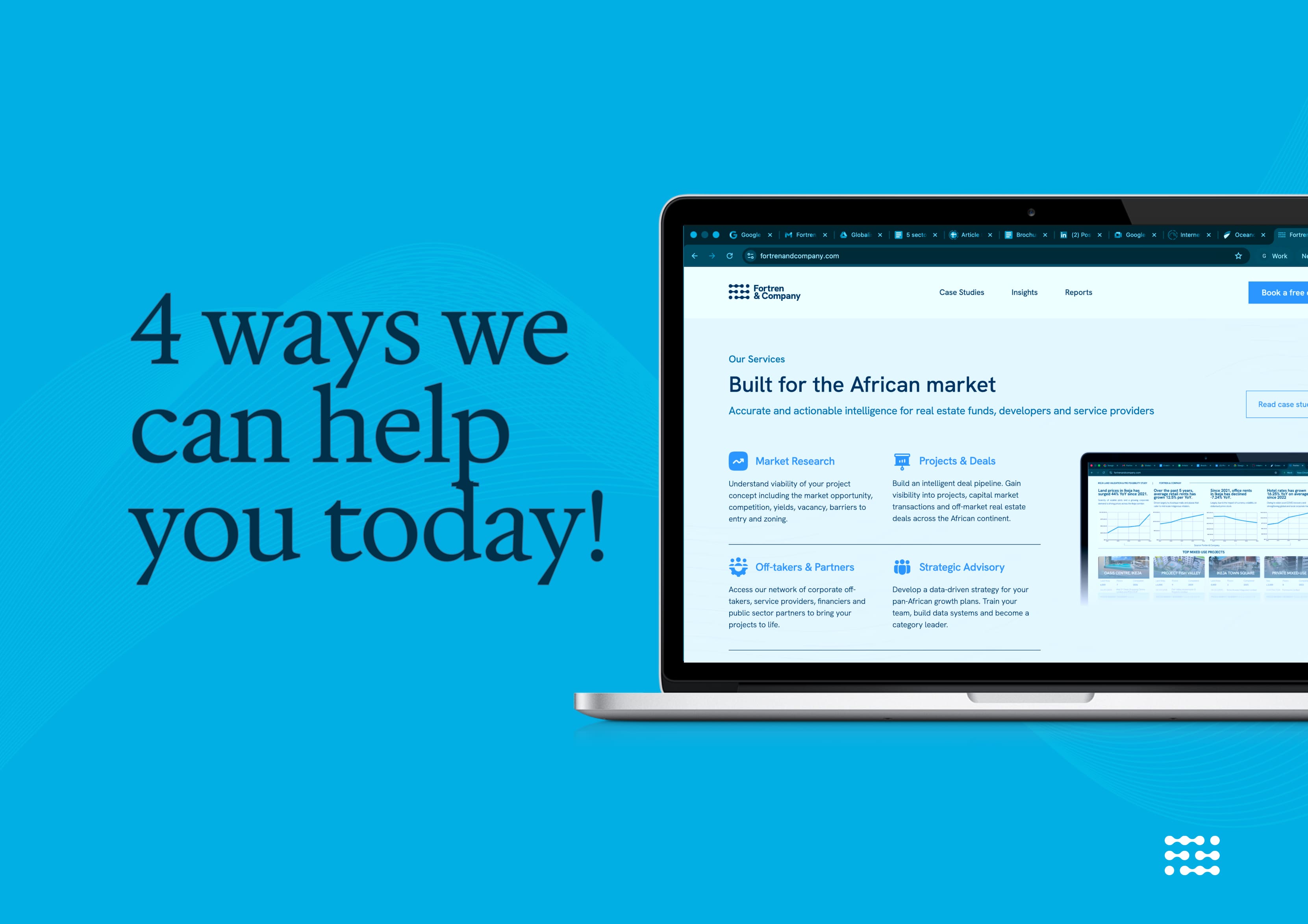
- Let's start with your market research service. What problem does Fortren & Company actually solve there?
Short answer: We help developers and real estate project sponsors objectively assess if their project is viable before they build it.
Most developers commit capital to projects without testing if it is actually viable. They build based on assumptions, or I would say pure optimism, and by the time the market responds, expensive decisions are already locked in. What we do with our market research service is help real estate developers and project sponsors objectively assess the market before committing capital. To be able to do that, we track historic data on the market including competition, achievable price points, yields, vacancy, and end user needs and preferences to help our clients see how their project will perform compared to the market. The majority of developers build based on asking market rates that don’t hold up so the key difference in our approach is we rely on achievable prices to help our clients get a true sense of the demand. We also run primary demand studies and talk directly to the buyers or tenants a project is meant to serve so the developer builds what the market actually needs.
If you have a project and like to see how it will perform in the market, speak to our advisory team here. - What about Projects and Deals, what does that offering solve?
Short answer: We help service providers and other institutions source deals that are not on the market yet.
Capital moves slowly in African real estate partly because information is poor. Investors hear about opportunities late, or they never hear about them at all, so everyone ends up competing for the same handful of visible deals. What we do is track projects, capital market transactions and off-market deals across key African cities, and build that into a live pipeline sourced from our network and relationships. Clients get a structured view of what is actually available, matched to their market of interest. This allows them to move on opportunities earlier than the rest of the market, and they get better pricing because they are not bidding against a crowded field for the same well-known deals.
If you are looking for exclusive real estate deals and off-market opportunities, speak to our advisory team here.
- Off-takers and partners: get to execution faster.
Short answer: We connect our clients with local partners to bring their project to live.This is a common one. Someone has capital, they have design intent, they have ambition, but no local partner who understands the terrain: land title issues, regulatory approvals, community relations. That is where foreign-led and even local projects usually lose time. A strong project with the wrong partner still fails, so due diligence on the partner has to carry the same weight as due diligence on the deal itself. What we do is draw on our network of corporate off-takers, service providers, financiers and public sector contacts, and screen for track record matched specifically to the client's asset class and price point, regardless of firm size. That gets clients from idea to execution faster, and the partnerships we help structure are built on clear terms from the outset, which is what makes them outlast the ones assembled under pressure.
If you are looking for a partner to help bring your project to live, speak to our advisory team here. - Strategic advisory: build a growth plan that holds up across markets.
Short answer: We help real estate institutions build a defensible strategy for the African market.
This is for institutions expanding across multiple African markets. The mistake we see repeated constantly is relying on instinct in every new city instead of building something repeatable. A strategy that worked in Lagos does not automatically transfer to Accra or Nairobi. What we do is help build the strategy that lets our clients scale across Africa. They expand with the same discipline and speed regardless of which market they enter next, and they are not dependent on outside consultants to make that possible.
If you are looking for a strategic partner to support your Pan-African vision, speak to our advisory team here.
Across all of our platforms, we also help real estate project owners and service providers showcase their projects and services to our audience. Speak to our team if you want to advertise your project or services.
We have supported over 50 projects across five African markets, de-risking more than $425 million in capital deployment for clients including CW Real Estate, Dutum Group, Terra Vista Developers, Medbury Healthcare Group, Venture Garden Group and Spacefinish.
We love your feedback. Let us know what you think about the work we do by sending an email to advisory@fortrenandcompany.com. You can also join the conversation here on LinkedIn.
If you need bespoke research on any asset real estate class across the continent, send an email to our advisory team at advisory@fortrenandcompany.com.
With just 3,577square meters in land mass, Lagos is home to over 17 million residents, making it one of the most densely populated cities in the world. One of the most pronounced effects of clear overpopulation in overcrowded cities like Lagos is the increase in informal settlements, land grabbing, and illegal construction. Internal data from the Lagos State government shows that more than 349 buildings have been erected illegally and do not comply with the planning laws set out by the state. In response, the Lagos State Building Control Agency (LASBCA) and the Ministry of Physical Planning and Urban Development have intensified enforcement of planning laws to ensure that buildings within Lagos State are designed, constructed, and maintained to a high standard of safety. Their enforcement efforts have led to numerous building demolitions and are primarily targeted at three recurring violations across the state, which we will be discussing below.
- Lack of building development permit:
- sdfds
-
Failure to obtain required development permits remains one of the most common triggers for demolition across Lagos. Under Section 27(1) of the Lagos State Urban and Regional Planning and Development Law, no building is allowed to be erected across the state, except when necessary permits and approvals have been duly sought and obtained. “No person shall carry out any development in Lagos State without obtaining a permit from the relevant planning authority.” Non-compliance with section 27(1) of the Lagos State Urban and Regional Planning and Development Law authorises the state government to demolish any building that has not sought and obtained the necessary approvals. Despite this clear guideline, unauthorised construction continues to proliferate in the state. In a recent enforcement action, 13 illegal buildingswere demolished in Lagos for non-compliance, highlighting the Government’s resolve to clamp down on developments that violate planning regulations. Several factors may explain why some developers bypass the approval process, including a lack of awareness of regulatory requirements, the perceived complexity or delay in obtaining permits, and, in some cases, a calculated risk to evade official fees or oversight. While these issues don’t justify non-compliance, they underscore the need for continued public education, transparency, and reform of the permitting process.
- Encroachment on Drainage Channels and Setbacks:
Building on drainage channels and designated setbacks stands out as one of the leading causes of demolition across Lagos. This issue not only breaches planning regulations but has also contributed to environmental and public safety risks.The Lagos State Building Control Agency(LASBCA) mandates a minimum setback of nine (9) meters for residential buildings in high-density, flood-prone zonessuch as Victoria Island, Apapa, and the Lekki Peninsula Schemes I and II. Despite these regulations, many developers have reclaimed and erected structures directly on waterways, obstructing water flow and increasing the risk of flooding. Recently, the Lagos state government marked 39 buildingsfor demolition in the Eti-Osa Local Government Area (mostly along the Ikota corridor) for obstructing drainage channels and encroaching.Similar actions have been taken in other areas like Amuwo Odofin. These demolitions have left many homeowners devastated. In response, affected owners have petitioned the government through their community associations, while others seek court injunctions to challenge the demolition or delay it pending clarification of their land status. Urban experts, however, emphasise the need for property buyers to secure proper planning permits from the Lagos StatePhysical Planning Permit Authority(LASPPPA) before embarking on any building or development project within the state.In many cases, properties built on canals, drainage channels, or government-designated right-of-way have little to no legal standing, making it difficult for affected owners to obtain compensation or favourable rulings in court. This is because such developments typically contravene established planning laws and are considered public safety hazards. We love your feedback. Let us know what you think about this article or your experience renting in Africa by sending an email toadvisory@fortrenandcompany.com. You can also join the conversation here onLinkedIn.
.jpg)
.jpg)
