The mandate
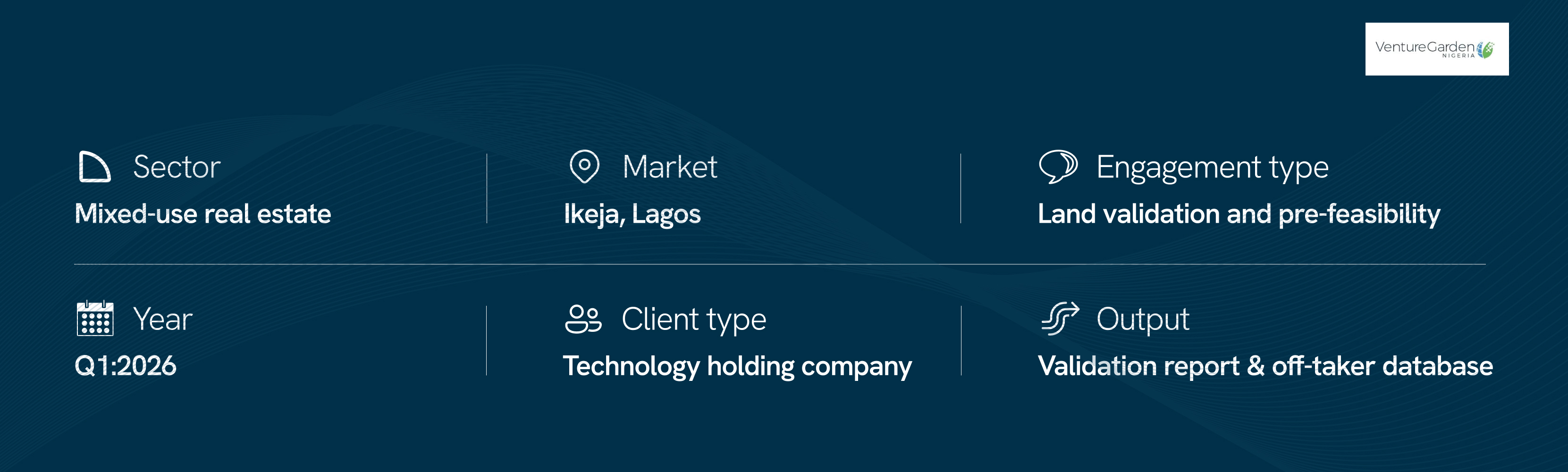
Venture Garden Group, a pan-African technology group, was evaluating the acquisition of a 4,867 SQM site on Airport Road, Ikeja, with the intention of developing a mixed-use innovation hub combining hospitality, office, and retail uses. The site was intended to serve as both the group's global headquarters and an income-generating commercial asset.
Before committing capital, the client required three things: an independent view on whether the land price was commercially justified relative to the Ikeja market; validation that demand existed across all three proposed uses; and a pre-qualified database of potential corporate off-takers to underpin the office component's commercial case. The engagement was designed as a prelude to a full financial feasibility study.
Our approach
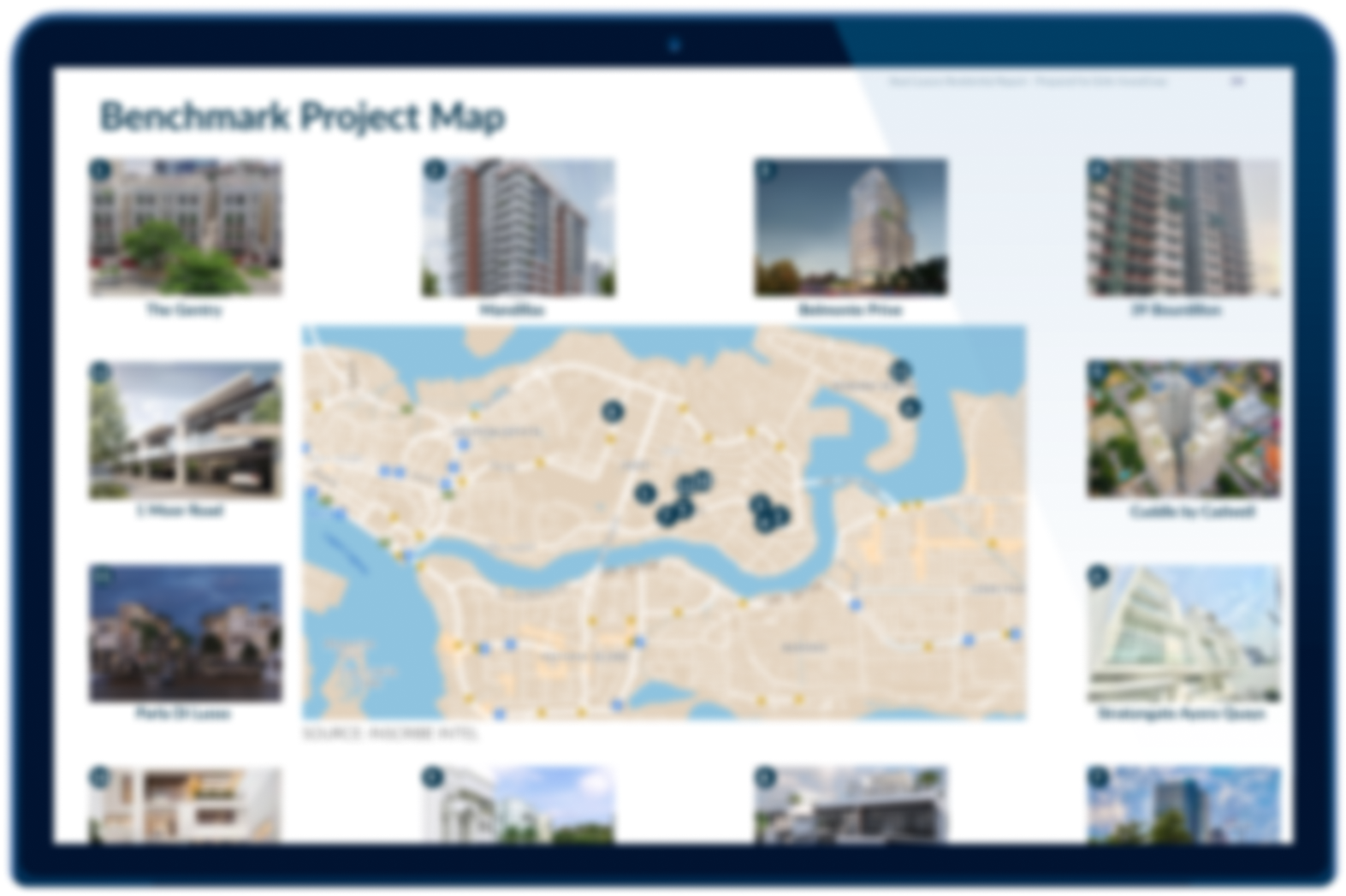
Fortren & Company structured the engagement across four parallel workstreams. The first benchmarked Ikeja asking land prices across sub-markets to establish a validated acquisition price range for the proposed site. The second assessed current supply, rents, average daily rates, and sector direction across hospitality, office, and retail in Ikeja, with competitive project mapping. The third involved a physical site visit, planning classification review under the Ikeja Model City Plan, infrastructure mapping, and FAAN height constraint identification. The fourth produced a database of 415 Lagos-based corporate occupiers across 12 sectors, with named decision-maker contacts, building grades, and credit indicators.
Market context
Ikeja is Lagos' administrative capital and primary airport corridor, with a catchment population of 470,200 and a median aggregate annual household spending of ₦208,955. Murtala Mohammed International Airport generates over 12 million domestic and international passengers annually, anchoring consistent corporate and institutional demand across all three proposed uses.
Land prices on the corridor have grown at an average of 44% per year since 2021, driven by scarcity of sizable plots and rising institutional demand. Retail rents have grown 12.5% per year over the past five years. Hotel average daily rates have grown 16.25% per year since 2022, reflecting post-COVID recovery and strengthening corporate travel. Traditional office rents have declined at an average of 7.24% per year since 2021, primarily due to the impact of currency volatility on dollarised prime stock and an oversupplied market.
Across all three sectors, the defining characteristic of the Ikeja market is the performance gap between average stock and premium or experience-led product. Better-specified, better-operated assets outperform the market materially in every category.
Hospitality: average daily rate of ₦124,103 across the market, with premium branded products commanding up to ₦512,238 per night. Sector direction: balanced. Office: average rent of ₦157,726 per SQM per annum across 395,739 SQM of total stock. Sector direction: oversupply. Retail: average rent of ₦139,200 per SQM across 230,140 SQM of formal stock. Sector direction: balanced.
.jpg)
Key findings
The site has planning alignment. The proposed site falls within the institutional and commercial mixed-use zone under the revised Ikeja Model City Plan, directly supporting the scale and character of the proposed concept. Airport Road functions as the economic spine of the district, concentrating the highest-intensity commercial activity on the Lagos mainland.
The corridor has proven institutional appetite. The presence of Marriott, Radisson Blu, Sheraton, and Hilton on the same corridor confirms that international operators and institutional investors are already underwriting Ikeja as a viable location for premium, income-generating assets. The spread between average ADR and premium branded ADR — over ₦388,000 per night, quantifies the quality premium available to well-positioned products.
Office requires product differentiation, not traditional GLA. Traditional office stock is oversupplied and under rent pressure. Selective opportunity exists in managed flexible office formats that serve hybrid and satellite teams, a product type that is currently underrepresented on the corridor and aligned to the client's corporate tenant profile.
The three proposed uses are commercially complementary. Hotel guests sustain F&B and experiential retail, flexible office occupiers drive consistent weekday footfall, and the combined activation strengthens the investment case for each component individually. Mixed-use developments structured around this logic outperform single-use assets on this corridor.
A pre-qualified corporate off-taker pool exists. The off-taker database identified 415 companies currently occupying commercial office space across Lagos, spanning 12 sectors led by financial services, energy, and ICT. The concentration of these firms in the increasingly constrained Victoria Island and Ikoyi corridors signals latent relocation demand that a well-specified mixed-use asset on Airport Road can directly intercept.
Strategic insight
The Ikeja airport corridor supports a mixed-use development of the proposed scale and character, but location alone is insufficient. Across all three sectors, better-specified and better-operated assets outperform the market materially. The site's commercial viability is contingent on operator quality, not just concept positioning.
The proposed site addresses a visible gap in Ikeja's commercial stock. The corridor has validated demand, planning alignment, and a proven institutional operator base. The determining factor in asset performance will be the quality of operator partners engaged across each use.
Recommendations
For the developer: confirm land title and FAAN height restrictions before commissioning design. Title quality and achievable density are the primary determinants of land value and the cost structure of the entire project.
For the operator: engage institutional-grade operator partners across all three proposed uses before design is finalised. On this corridor, operator quality is the primary driver of performance variance between comparable assets.
For the developer on product positioning: target premium branded hospitality, managed flexible office, and experiential F&B-anchored retail. The airport catchment rewards activation and experience delivery. Goods-led GLA is structurally misaligned to how demand on this corridor is moving.
For the investor: commission a full financial feasibility study before capital is committed. The pre-feasibility findings support the viability of the concept. Translating that into investment returns requires detailed financial modelling on GFA, operator terms, construction costs, and yield assumptions.
Outcome
The engagement provided the client's leadership with an independent, data-backed basis for evaluating the land acquisition decision. The validated price range gave the client a negotiation anchor relative to the asking price. The sector analysis and off-taker database reframed the project's commercial positioning, shifting focus from traditional office GLA toward managed flexible workspace and experience-led retail formats more closely aligned to the corridor's demand profile and the client's own corporate ecosystem. The engagement concluded with a full financial feasibility study commissioned as the next phase.
If you need bespoke research on any asset real estate class across the continent, send an email to our advisory team at advisory@fortrenandcompany.com.