The mandate
A Lagos-based investment group with a diversified asset portfolio was evaluating the development of a luxury residential scheme on a 5,300 SQM plot in Ikoyi. The client's initial concept involved five units of fully detached five-bedroom houses, targeting the upper end of Lagos's high-net-worth residential market.
The complication was visible before the brief was fully scoped. Ikoyi's luxury residential market was at an inflection point: developer activity had intensified sharply, a large pipeline of premium units was approaching completion, and the buyer pool — already narrow by design, was under measurable pressure from currency devaluation and declining purchasing power among the naira-denominated wealthy. The client's stated return target of two times invested capital, combined with a deliberate preference for a low unit count, made the financial case harder to construct in that environment.
The question the engagement needed to answer was not simply whether the site was viable, but whether the proposed concept as structured could achieve the client's return expectations, and if not, what adjustments would change that outcome. Fortren was retained to provide independent market intelligence, a site and planning assessment, a competitive benchmark study, and a financial feasibility model to support the investment decision.
Our approach
Fortren structured the engagement across four analytical workstreams. The first assessed Nigeria's macroeconomic environment, with particular attention to the variables most directly affecting luxury residential demand: inflation, foreign exchange dynamics, real estate sector GDP contribution, and alternative asset performance relative to equities.
The second workstream mapped Ikoyi's luxury residential supply and demand landscape in detail. On the supply side, this included a tracking exercise across completed stock and the active development pipeline, segmented by unit grade from deluxe through to ultra-luxury. Demand analysis examined buyer typologies, purchasing behaviour, the role of dollar-denominated pricing in shaping effective demand, and the structural influence of HNI liquidity on occupancy and absorption.
The third workstream covered the proposed site directly: zoning classification under the Ikoyi-Victoria Island Model City Plan, infrastructure mapping, connectivity analysis, and a SWOT assessment of the specific plot relative to the surrounding development environment.
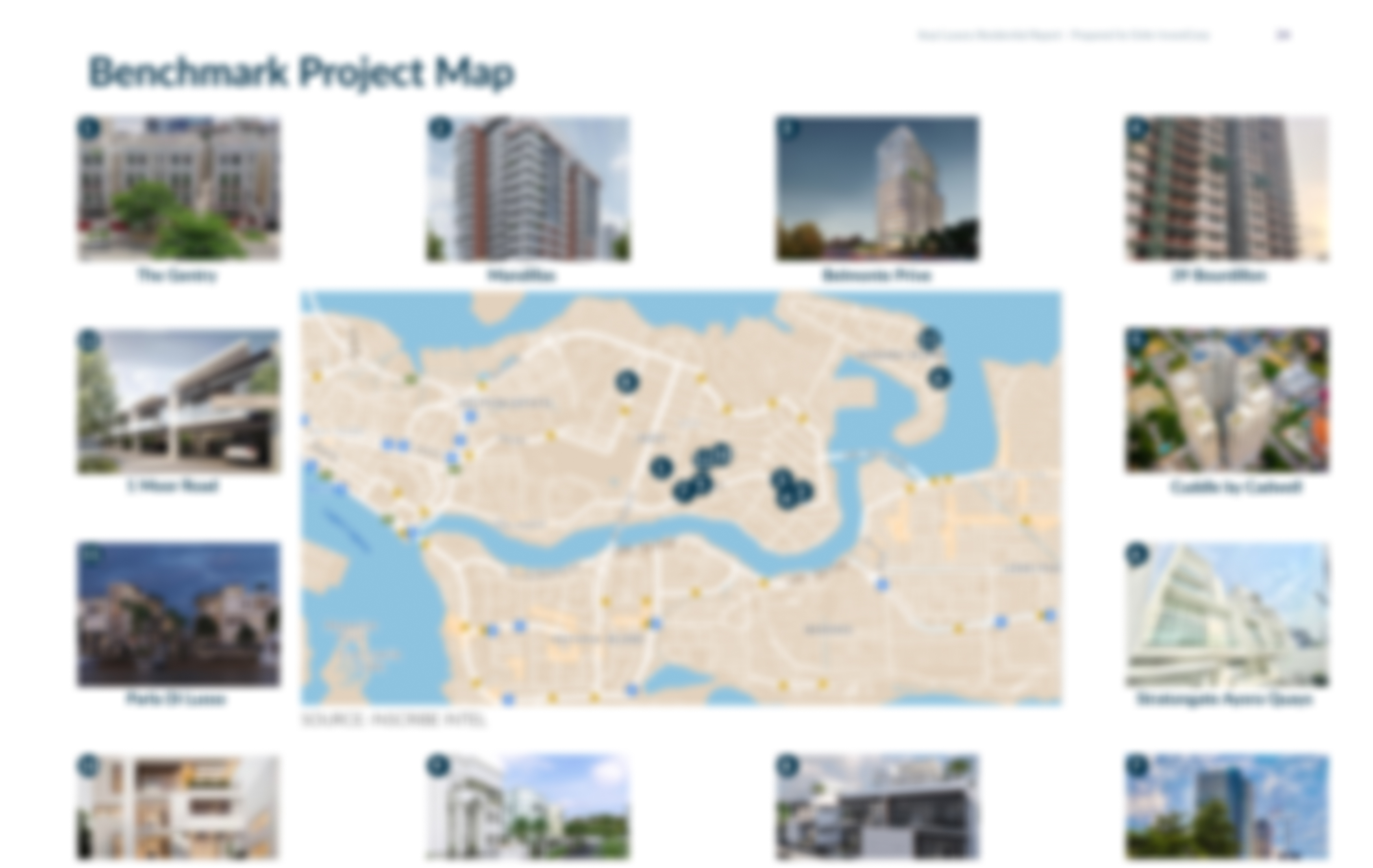
The fourth produced a benchmark study of eleven comparable projects across Ikoyi and Banana Island, examining unit specifications, construction grades, sale prices, amenity profiles, and delivery timelines. This database gave the client a precise competitive reference set for product positioning and pricing decisions.
Key findings
6,400 completed luxury and ultra-luxury units currently tracked across the Lagos market, with a further 2,700 units in the pipeline at the time of analysis.
753 new units priced at $1 million or more projected for delivery by 2027, representing a 33% increase in construction activity year-on-year across the Ikoyi BAG stretch, Victoria Island, and Banana Island.
$550,000 to $6.3 million the sale price range observed across benchmarked five-bedroom luxury and ultra-luxury projects in Ikoyi and Banana Island.
8,200 Nigerians holding private wealth of $1 million or more in 2024, of whom only 23 exceed $100 million, quantifying the effective buyer pool for the upper segment of the market.
The benchmark study revealed a consistent pattern across projects: pools, gyms, and elevators have become baseline requirements rather than differentiators, while private cinemas, smart home automation, and bespoke imported finishes now function as the primary markers of premium positioning. More significantly, pre-launch sellouts at projects like Claren Villas, achieved before public listing, confirmed that scarcity signalling, rather than traditional marketing, drives buyer urgency at the top of the market. The implication for the client's concept was direct: with a low unit count and a prime address, artificial scarcity was a structural advantage available to the project if executed with sufficient speed and product discipline.
Strategic insight
"Ikoyi's luxury residential market rewards precision. With 753 units priced above $1 million entering the market by 2027, generic luxury is no longer a positioning. The projects that will absorb demand are those that match the right product format to the right buyer segment, arrive before the pipeline peaks, and control costs tightly enough to price competitively without sacrificing the quality signals that HNI buyers use as a proxy for credibility."
The fundamental dynamic shaping the market is the mismatch between growing supply and a buyer pool that is contracting in real terms. Dollar pricing protects developers from naira volatility, but it also narrows the effective purchaser universe to Nigerians with direct access to foreign exchange, a group that is smaller, and more risk-selective, than headline wealth figures suggest. In this environment, the strongest indicator of project success is not the size of the market; it is the liquidity and decisiveness of the specific buyer segment the product is designed for. The client's low unit count was not a constraint, it was a commercial asset, provided the concept was sharp enough to warrant the price premium.
Recommendations
For the developer on land acquisition: target a land cost closer to the $3 million to $4 million range. Achieving this requires structured negotiation and, potentially, non-cash incentives to the vendor. The financial model showed that this adjustment alone reduces total project cost by approximately 20%, creating meaningful headroom to price competitively or extend margin or both.
For the developer on product mix: expand the concept to include six and seven-bedroom typologies alongside the original five-bedroom brief. Larger units command higher revenue per square metre in Ikoyi's HNI market, where buyers at the ultra-luxury tier prioritise exclusivity and scale over unit economics. The inclusion of larger formats also allows tiered pricing across a small number of units, improving blended revenue without increasing the build programme materially.
For the developer on delivery: treat speed to market as a first-order commercial variable. The oversupply risk crystallises between 2026 and 2027. Projects that reach practical completion before that window benefits from a demand pool that has not yet been spoiled for choice. Speed must not come at the expense of finish quality, in this buyer segment, execution credibility is assessed through contractor pedigree and observable build standards, not marketing, but the financial cost of delay is material.
For the investor on contractor selection: the benchmark study confirmed that named contractors with a visible Ikoyi track record — firms such as El-Alan Construction — directly influence buyer confidence in off-plan commitments. Contractor pedigree functions as a credibility signal in a market where buyers are committing significant capital to unbuilt product. This decision should be made before launch, not after.
Outcome
The engagement gave the client's leadership an independent, evidence-based foundation for evaluating both the acquisition decision and the product concept. The market analysis validated the investment thesis at a structural level — Ikoyi remains a credible destination for premium residential capital, while identifying the conditions that determine whether a specific project captures that opportunity or misses it.
The financial model and cost benchmarking reframed the land negotiation, giving the client a quantified basis for the price it was willing to pay and the commercial consequences of overpaying. The benchmark study reshaped the product brief, shifting the unit mix toward larger typologies and tightening the specification strategy around the amenity and finish standards that matter to the relevant buyer segments. The engagement concluded with a clear set of decision inputs: a negotiated land target, a revised product concept, and a sequenced development timeline calibrated to deliver ahead of the pipeline peak.
If you need bespoke research on any asset real estate class across the continent, send an email to our advisory team at advisory@fortrenandcompany.com.