.jpg)
The mandate
A leading Nigerian construction and real estate development company with over three decades of experience and more than 130 completed projects had identified a joint venture opportunity with a listed corporate landowner in Lekki Phase 1. The landowner held a 2,030 SQM prime plot, a strategic asset generating no current income and was open to a structured development partnership to unlock its value.
The complication was not the development opportunity itself, which was straightforward in outline. It was the nature of the audience. Persuading a listed company to commit a prime asset to a joint venture requires a materially different quality of evidence than a standard developer-to-developer negotiation. The board and management of a publicly listed firm are accountable to shareholders, constrained by governance requirements, and alert to reputational risk. A proposal without a credible market case, an independently grounded financial model, and a clearly articulated partnership structure would not reach the decision threshold, regardless of the developer's track record.
The question the engagement needed to answer was whether the site, as configured, could support a mixed-use development that met the financial return expectations of both parties, and what product format, development cost structure, and partnership terms would give the proposal the best chance of acceptance. Fortren was retained to provide the market intelligence and financial analysis underpinning the proposal.
Our approach
Fortren structured the advisory across three parallel workstreams. The first assessed the Lekki Phase 1 market across the two proposed uses — commercial office and premium residential, examining current rental yields, demand drivers, supply pipeline, and the structural factors shaping product performance in the submarket. This included a direct assessment of the competitive advantage available to a well-specified new-build asset in an environment defined by rising construction costs and constrained land supply.
The second workstream covered site analysis: zoning classification under Lagos State planning guidelines, infrastructure mapping, connectivity assessment across key Lagos corridors, and a SWOT analysis of the specific plot relative to the surrounding development environment. The site sits within a mixed-use, high-density zone and benefits from direct road access to Victoria Island, Ikoyi, and Ikate, a connectivity profile that strengthens the commercial case for both uses.
The third workstream produced the development mix and financial model. This involved designing a viable product configuration across 41 units and a ground-floor office component within the site's built envelope, then constructing a full development cost breakdown, land, construction, financing, and cost apportionment by use, alongside a revenue model and profit analysis to support the go-decision.
Key findings
₦11.94 billion total development cost across land value, construction and development costs, and interest on capital, with residential accounting for 77% of the total cost structure and office for the remaining 23%.
₦14.35 billion projected residential sale value across 41 units — 35 two-bedroom apartments and 6 four-bedroom maisonettes — on a total built-up area of 11,914.7 SQM across both blocks.
36% projected residential profit margin, representing an absolute profit of ₦5.14 billion on the residential component alone, before accounting for the long-term income yield on the office component.
8–10% rental yield range for Grade-A commercial office space in Lekki Phase 1, with strong unmet demand for flexible, serviced formats from corporate occupiers and SMEs, a product type structurally underrepresented in the current submarket supply.
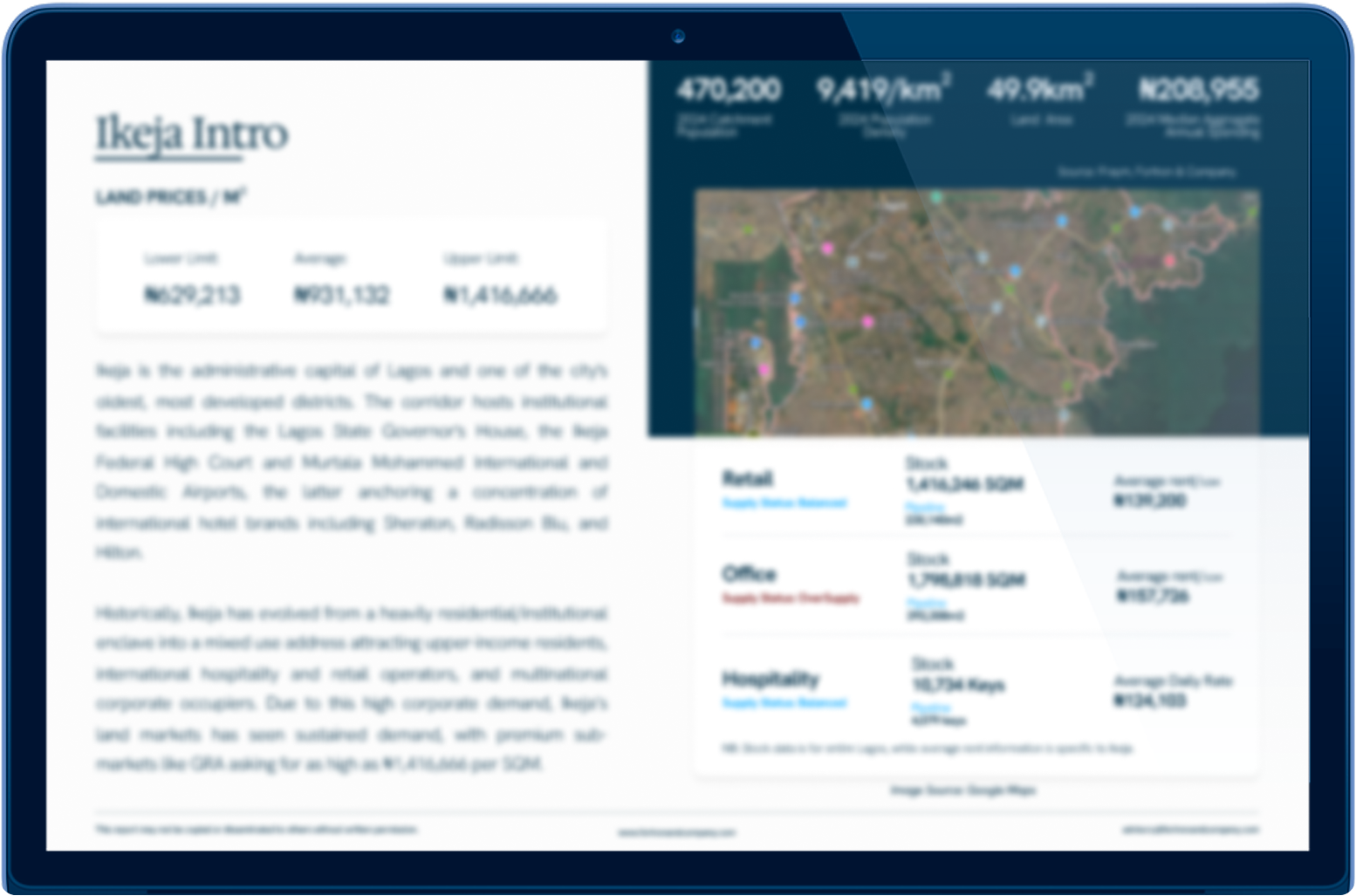
The market analysis confirmed that Lekki Phase 1 occupies a distinct position in Lagos's commercial and residential hierarchy. It sits at the intersection of premium residential demand driven by HNI buyers, expatriates, and corporate tenants, and sustained Grade-B+ office demand from firms seeking proximity to Victoria Island without Victoria Island land and rental costs. The defining characteristic of the submarket at the time of analysis was the gap between what existing stock delivers and what a well-specified new-build asset, executed with quality and speed, can command. The development proposal was designed to occupy that gap directly.
Strategic insight
"A JV proposal to a listed company is an investment thesis. The landowner's question is not whether the developer can build; it is whether the asset, once built, will perform at the level that justifies committing the land. The financial model, the market evidence, and the governance structure are not supporting documents. They are the proposals."
The broader market observation that anchors this engagement is one that applies across Lekki Phase 1 and comparable Lagos submarkets: the constraint on premium mixed-use development is not demand, which is demonstrably present, but execution credibility. In an environment where construction costs are rising, currency risk is real, and delivery timelines are routinely missed, a developer who can demonstrate financial capacity, contractor pedigree, and a structured governance framework, independently validated, holds a material advantage over one who cannot. The advisory work done for this engagement was not supplementary to the proposal; it was the instrument that gave the developer's track record a verifiable commercial context.
Recommendations
For the developer on JV structuring: formalise the profit-sharing and exit strategy terms before entering detailed design. The financial model supports a go-decision, but the alignment of return expectations, and the mechanism for resolving disagreement during delivery, must be documented before planning submissions, not after.
For the developer on product positioning: the market case for Grade-B+ flexible offices at ground level is stronger than for traditional lettable office GLA. The Lekki Phase 1 demand profile favours managed, serviced formats that corporate occupiers can absorb without long procurement cycles. This positioning also reduces vacancy risk materially during the lease-up phase, which is the primary financial risk in the office component.
For the landowner on governance: the establishment of a Joint Steering Committee with transparent milestone tracking and reporting is not a courtesy mechanism, it is the primary protection against cost overruns and schedule drift in a market where both are common. The governance framework should be treated as a commercial term, not a post-agreement administrative arrangement.
For both parties on delivery sequencing: speed to market is a first-order variable in this submarket. Rising construction costs, naira volatility, and a growing development pipeline all erode the financial case with each quarter of delay. The LOI and regulatory approval process should run concurrently, not sequentially.
Outcome
The engagement gave the developer a proposal that met the evidentiary standard required to initiate serious negotiations with a publicly listed counterparty. The market analysis grounded the financial projections in independently validated yield and demand data, shifting the conversation from a contractor pitch to an investment case. The development mix and cost model gave the landowner a clear view of projected returns across both uses, with a profit margin on the residential component that supported the commercial logic of the partnership. The proposal was submitted in March 2025, with the next phase of the engagement structured around detailed feasibility and formal project agreement upon execution of a Letter of Intent.
This case study has been prepared for illustrative purposes. Financial projections reflect the advisory analysis at the time of the engagement and are not forward-looking guarantees. Certain engagement details have been withheld in accordance with Fortren's confidentiality standards.
If you need bespoke research on any asset real estate class across the continent, send an email to our advisory team at advisory@fortrenandcompany.com.