
Fortren & Company partners with FIABCI to advance real estate conversations across Africa

Fortren & Company is partnering with the International Real Estate Federation (FIABCI) to advance real estate, construction, and infrastructure conversations in Africa through strategic thought leadership initiatives. The partnership brings together Fortren's research depth and FIABCI's global network to create a recurring series of webinars, panel sessions, and publications that foster transparency and collaboration across the continent.
Olapeju Aderemi
July 5, 2026
·
3 mins
Share

Fortren & Company is partnering with the International Real Estate Federation (FIABCI) to advance real estate, construction, and infrastructure conversations in Africa through strategic thought leadership initiatives.

The partnership brings together Fortren's research depth and FIABCI's global network to create a recurring series of webinars, panel sessions, and publications that foster transparency and collaboration across the continent.

Fortren & Company partners with FIABCI to advance real estate conversations across Africa

Why this matters

For decades, Africa's property markets and broader economy have struggled to command the attention they deserve in global investment and policy rooms. This series gives investors, developers, financiers, and policymakers sharper, evidence-based insight on Africa.

The initiative carries the direct support of Lily Chang, FIABCI World President, who serves as chief host, and Akin Opatola, President of FIABCI Nigeria and Principal Partner at Olawale Jordan Company. Their backing gives the series global reach through FIABCI's international network and local credibility through Nigeria's leading real estate body.

First session: What does the Iran-Israel conflict mean for Africa's real estate and construction sector?

The first webinar in the series addresses a question that has moved from background risk to active business concern in boardrooms across the continent: the impact of the Iran-Israel conflict on Africa's real estate and construction sector.

The disruption has not stayed contained to the Middle East. Energy costs, shipping routes, and the price of imported building materials sit downstream of the conflict, and African developers, contractors, and facility managers are already absorbing the consequences through delayed projects, tighter margins, and service charges that no longer cover the cost of running an estate. 

This session puts that impact in front of the people building, financing, and operating property across the region, with the aim of helping them navigate this season.

The session will be held on 21 July at 11:00 AM WAT, live on LinkedIn.
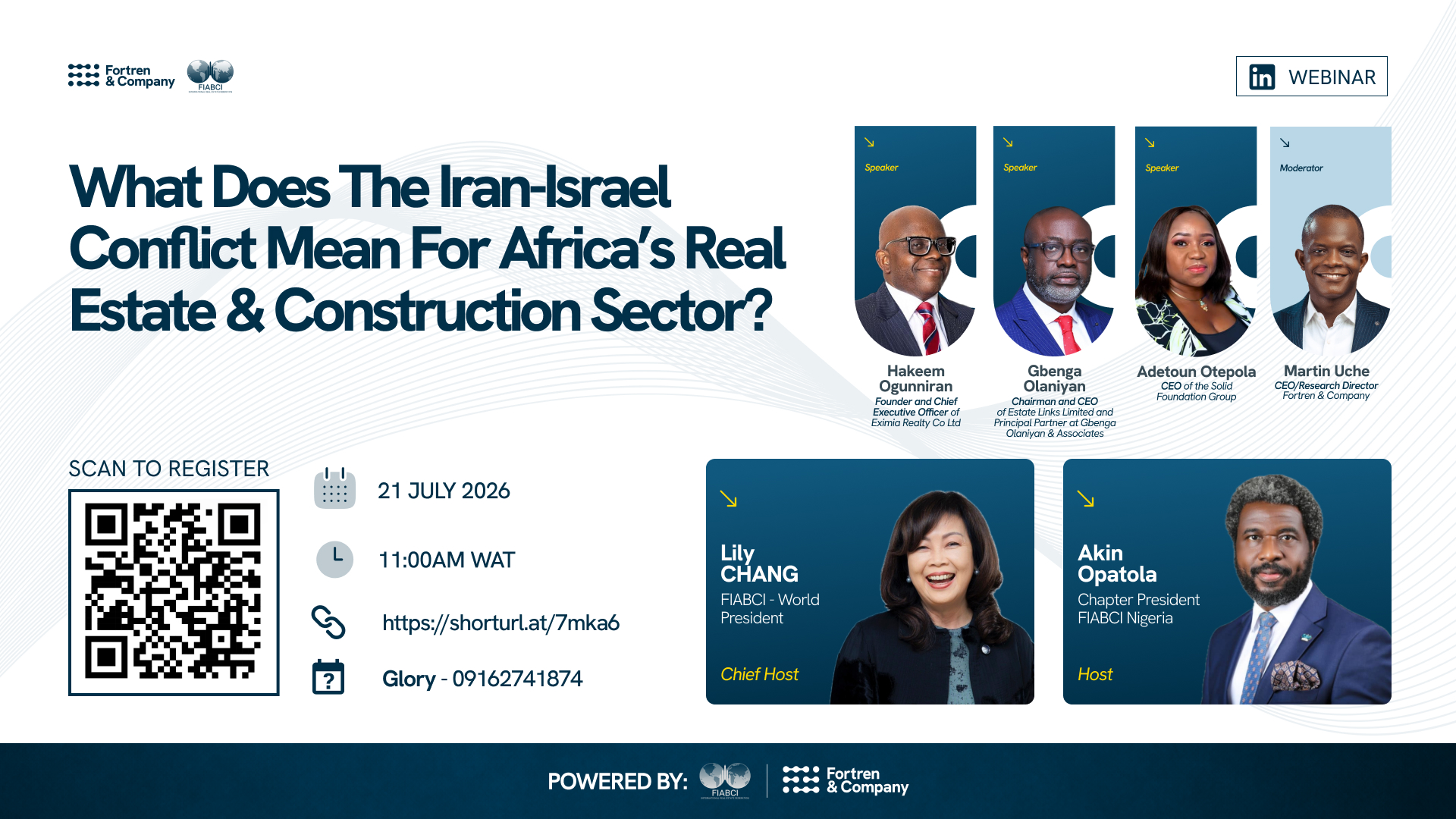
What does the Iran-Israel Conflict Mean For Africa’s Real Estate & Construction Sector?

Speakers

  • Hakeem Ogunniran, Founder and Chief Executive Officer, Eximia Realty Co Limited
  • Gbenga Olaniyan, Chairman, Estate Links Limited, and Principal Partner, Gbenga Olaniyan & Associates
  • Adetoun Otepola, Chief Executive Officer, Solid Foundation Group

Chief host: Lily Chang, FIABCI World President Host: Akin Opatola, President, FIABCI Nigeria Moderator: Martin Uche, Fortren & Company

Registration is open now. Scan the QR code on the event flyer or use this link to register. Direct any questions ahead of the session to team@fortrenandcompany.com.

With just 3,577square meters in land mass, Lagos is home to over 17 million residents, making it one of the most densely populated cities in the world. One of the most pronounced effects of clear overpopulation in overcrowded cities like Lagos is the increase in informal settlements, land grabbing, and illegal construction. Internal data from the Lagos State government shows that more than 349 buildings have been erected illegally and do not comply with the planning laws set out by the state. In response, the Lagos State Building Control Agency (LASBCA) and the Ministry of Physical Planning and Urban Development have intensified enforcement of planning laws to ensure that buildings within Lagos State are designed, constructed, and maintained to a high standard of safety. Their enforcement efforts have led to numerous building demolitions and are primarily targeted at three recurring violations across the state, which we will be discussing below.

  1. Lack of building development permit:
  1. sdfds

Failure to obtain required development permits remains one of the most common triggers for demolition across Lagos. Under Section 27(1) of the Lagos State Urban and Regional Planning and Development Law, no building is allowed to be erected across the state, except when necessary permits and approvals have been duly sought and obtained.

“No person shall carry out any development in Lagos State without obtaining a permit from the relevant planning authority.”

Non-compliance with section 27(1) of the Lagos State Urban and Regional Planning and Development Law authorises the state government to demolish any building that has not sought and obtained the necessary approvals. Despite this clear guideline, unauthorised construction continues to proliferate in the state. In a recent enforcement action, 13 illegal buildingswere demolished in Lagos for non-compliance, highlighting the Government’s resolve to clamp down on developments that violate planning regulations. Several factors may explain why some developers bypass the approval process, including a lack of awareness of regulatory requirements, the perceived complexity or delay in obtaining permits, and, in some cases, a calculated risk to evade official fees or oversight. While these issues don’t justify non-compliance, they underscore the need for continued public education, transparency, and reform of the permitting process.

  1. Encroachment on Drainage Channels and Setbacks:

Building on drainage channels and designated setbacks stands out as one of the leading causes of demolition across Lagos. This issue not only breaches planning regulations but has also contributed to environmental and public safety risks.The Lagos State Building Control Agency(LASBCA) mandates a minimum setback of nine (9) meters for residential buildings in high-density, flood-prone zonessuch as Victoria Island, Apapa, and the Lekki Peninsula Schemes I and II. Despite these regulations, many developers have reclaimed and erected structures directly on waterways, obstructing water flow and increasing the risk of flooding. Recently, the Lagos state government marked 39 buildingsfor demolition in the Eti-Osa Local Government Area (mostly along the Ikota corridor) for obstructing drainage channels and encroaching.Similar actions have been taken in other areas like Amuwo Odofin. These demolitions have left many homeowners devastated. In response, affected owners have petitioned the government through their community associations, while others seek court injunctions to challenge the demolition or delay it pending clarification of their land status.

Urban experts, however, emphasise the need for property buyers to secure proper planning permits from the Lagos StatePhysical Planning Permit Authority(LASPPPA) before embarking on any building or development project within the state.In many cases, properties built on canals, drainage channels, or government-designated right-of-way have little to no legal standing, making it difficult for affected owners to obtain compensation or favourable rulings in court. This is because such developments typically contravene established planning laws and are considered public safety hazards.
We love your feedback. Let us know what you think about this article or your experience renting in Africa by sending an email toadvisory@fortrenandcompany.com. You can also join the conversation here onLinkedIn.

Similar Insights

Read our thoughts on related topics that might interest you

See all insights