

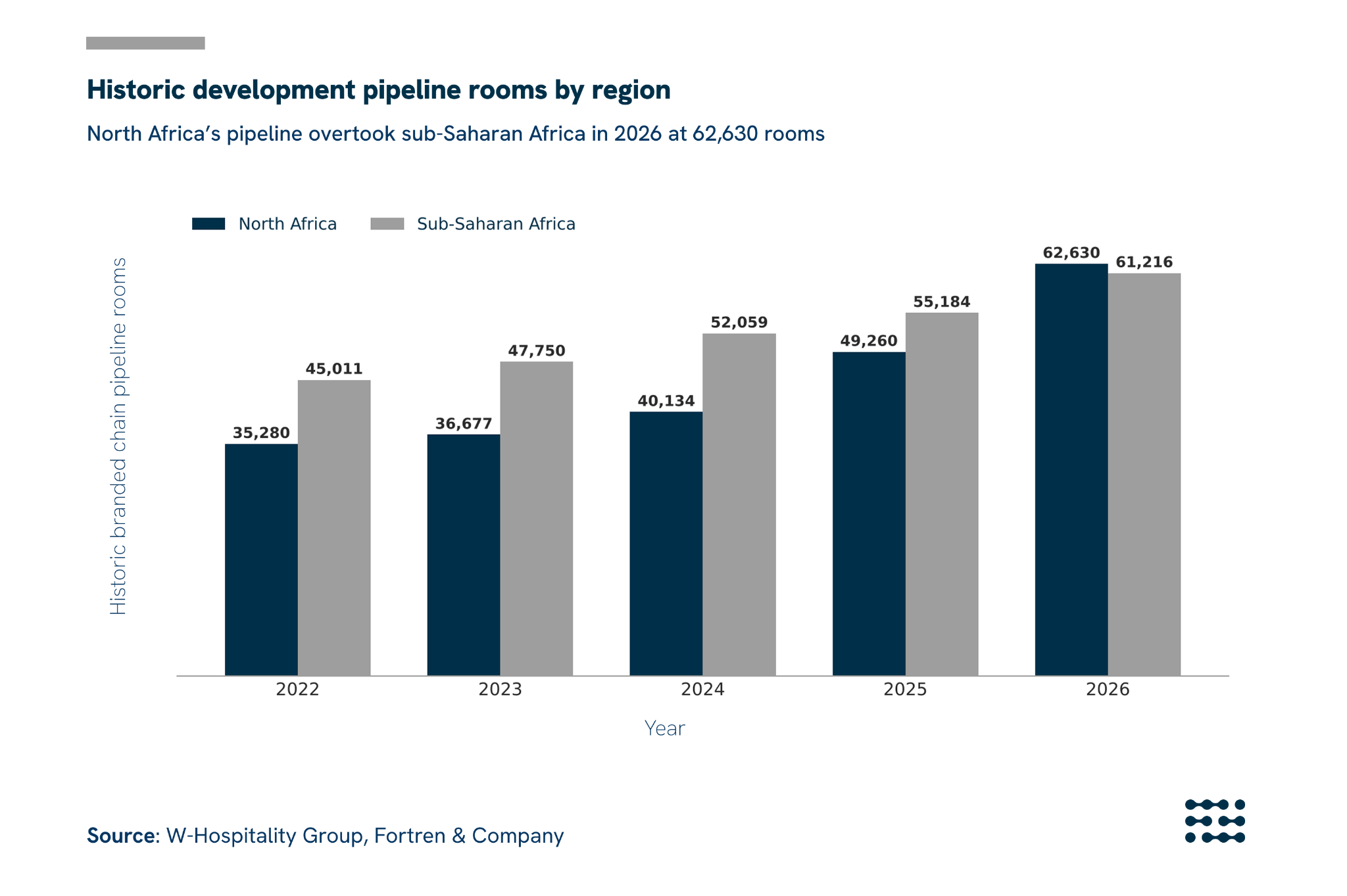
According to data from W Hospitality Group's "Hotel Chain Development Pipelines in Africa 2026" report, Africa has 675 branded hotels and resorts, with 123,846 rooms in the development pipeline. W Hospitality Group tracked data from 53 international and regional (African) hotel chains, showing that development activity has been growing impressively in North Africa, which saw a 27% year-on-year increase in pipeline rooms, mostly in Morocco and Egypt, compared to an 11% increase in sub-Saharan Africa.
Only about 10%-30% of Africa's planned hotel pipeline opens each year, and the pipeline has grown every year since 2022, from 80,291 rooms to 123,846 rooms. The new contracts carry opening dates from 2026 to 2029, with 18% of rooms still to be dated. It has led to a consistent question: why are so many branded hotel management contracts being signed, who will build them, can demand absorb the incoming supply, and what does this mean for the continent's hospitality market?
This has been an ongoing internal discussion among Fortren & Company analysts, and last week, we got Trevor Ward, Founder at W Hospitality Group and Heri Bomani, CEO at 255 Real Estate on our webinar to unpack this. This article summarises the conversation, and a few of our thoughts on the subject.
Why are new contracts being signed, and who is behind them?
Chains sign on owners' assets, and net unit growth rewards every signing.
Hotel chains do not fund the hotels they brand. Trevor put it plainly that branded hotel chains do not invest in hotels “almost literally globally” and look for investors to build for them. With few exceptions, the chains typically hold little or no financial investment in the assets themselves and net unit growth is one of the measures analysts use to move chain share prices. For the chains, “no pipeline, means no growth.”
Franchising is the fastest-growing contract type, lowering the barrier to entry and giving chains a lower-risk route to net unit growth.
Management agreements still account for 509 hotels and 98,361 rooms, over 75% of the pipeline. Franchised hotels have grown from 40 in 2020 (below 10% of the pipeline at the time) to 146 today, almost 22%, with Marriott International holding 69 of them. Franchise signings are up around 35% on last year, more than double the growth rate of management agreements. For these chains, franchising offers the fastest route to market, a lower barrier to entry and a lower-risk path to net unit growth. We do not expect this to change or slow down at least in the short to medium term.
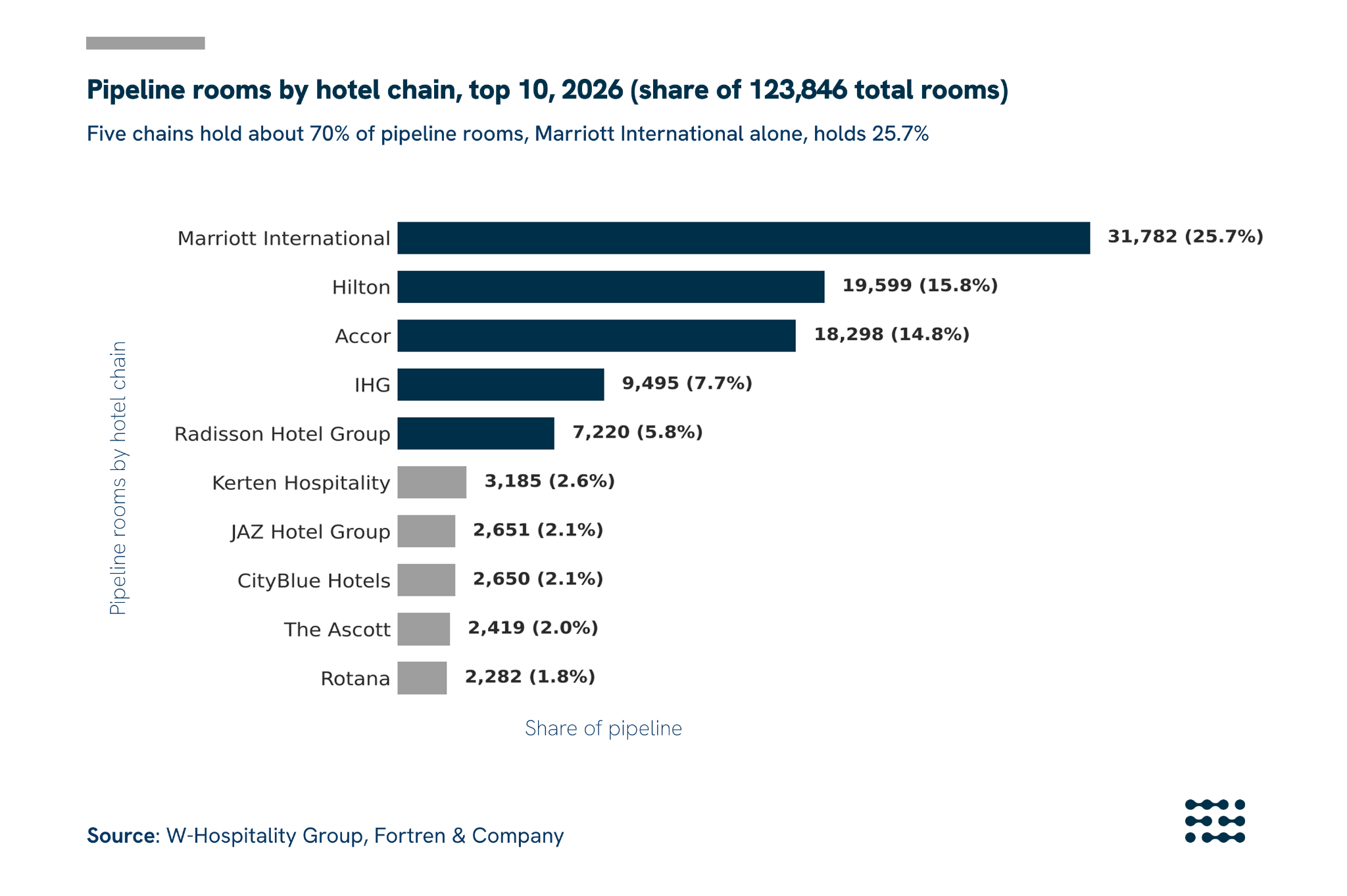
In terms of “the who”, five chains including Marriott, Hilton, Acor, IHG and Radisson hold about 70% of the pipeline.
Marriott International leads the pipeline with 31,782 rooms (25.7%), ahead of Hilton (15.8%), Accor (14.8%), IHG (7.7%) and Radisson Hotel Group (5.8%). What is interesting is that challengers are growing faster. Marriott's pipeline grew 7% in 2025, against 22% for Accor and 15% for Hilton. CityBlue Hotels (up 183% to 2,650 rooms, mostly in Kenya) and Kerten Hospitality (up 69% to 3,185 rooms, mostly in Egypt) grew fastest off smaller bases. Four first-time contributors, Choice Hotels International, JAZ Hotel Group, Oásis Atlântico and Rotana, added 6,636 rooms. We expect this trend to continue in the short to medium term as new challengers, with more room for growth, compete for market share.
Where will this supply be delivered?
Governments that get it, attract the signings.
The world’s first filter for where development lands is policy and Trevor alluded to this point. Investment follows countries “where the government gets it.” Accor's Maya Ziade points to Egypt's Vision 2030 target of 30 million tourists a year. Accor's Réda Faceh reports nearly 20 million international arrivals in Morocco in 2025, up 14%, with the 2030 FIFA World Cup ahead. Benin, which Trevor believes is smaller than Lagos by population, has three internationally branded hotels open or under construction, led primarily by government investment with Accor, Club Med and Banyan Group as operators. The signing count measures chain appetite for individual African cities, which is largely underpinned by policy, political stability and the overall macro environment.
In terms of “the where”, North Africa holds half of the pipeline, in four countries.
North Africa has 62,630 rooms (c.50%) across 284 hotels in Algeria, Egypt, Morocco and Tunisia. Sub-Saharan Africa has 61,216 rooms across 391 hotels in 38 countries. The two regions are 2% apart, and North Africa moved ahead for the first time since 2012. North Africa averages over 70 pipeline hotels per country, against just over 10 in sub-Saharan Africa. By sub-region, West Africa holds 21% of rooms, East Africa 16%, Southern Africa 9% and Central Africa 4%.
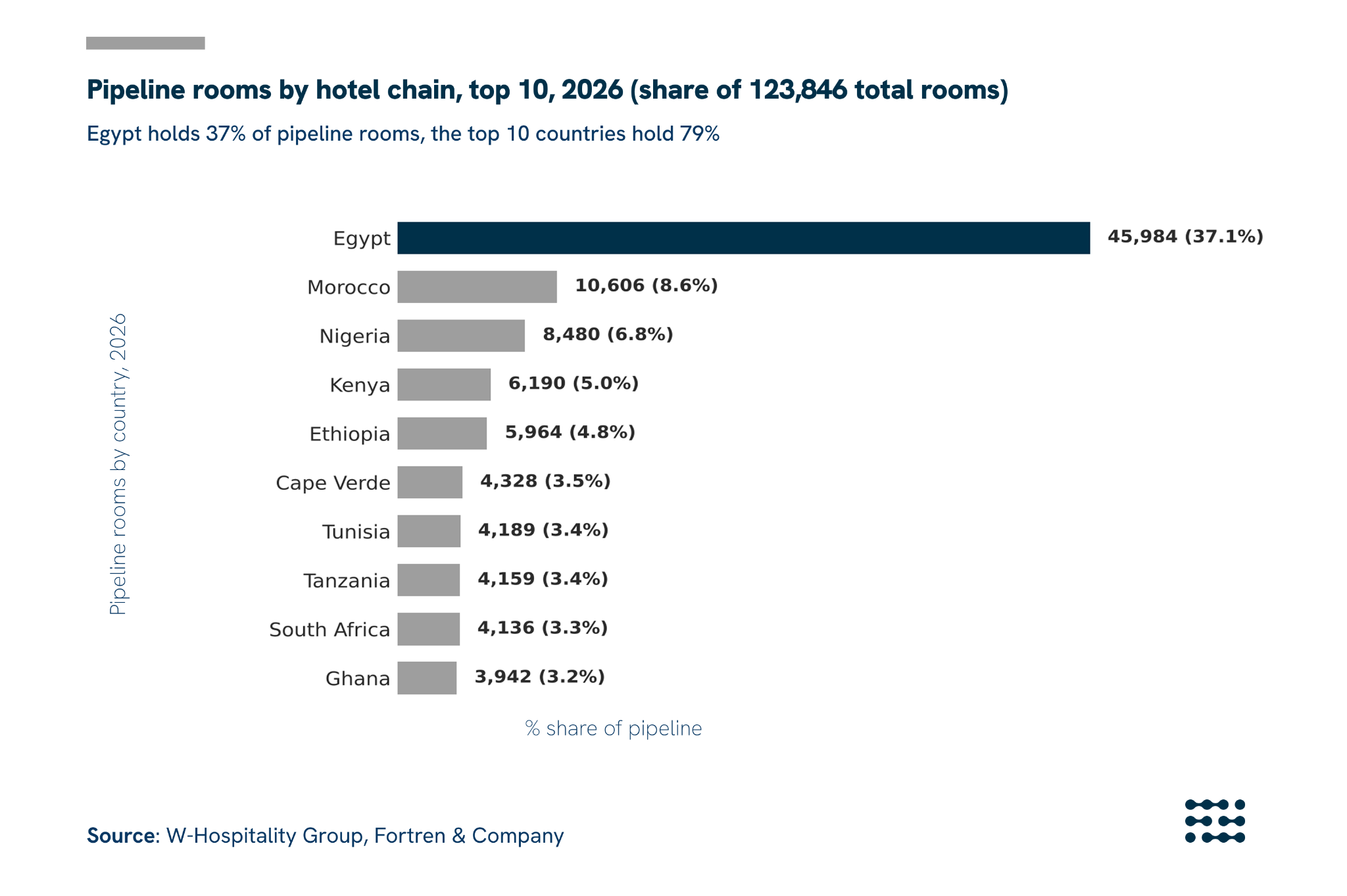
Egypt alone holds 37% of pipeline rooms, and Greater Cairo holds 18%.
Egypt has 185 hotels and 45,984 rooms, up from a 32.5% share in 2025 and four times Morocco's 10,606 rooms. Greater Cairo has 22,111 rooms, led by Accor (28 hotels), Marriott International (20), Hilton (18) and IHG (14). Seven of the ten largest projects in the pipeline sit in Egypt, and the ten average 835 rooms against 183 for the full pipeline. Trevor describes the format as “big beach boxes”, and credits a government that “understands tourism” for the volume.
Resorts are growing faster than city hotels.
Resort rooms grew 27.4% to 45,362, against 16.6% for city hotels, which reached 77,635. The average resort has 205 keys, against 174 for a city hotel. Sharm El Sheikh (4,851 rooms), Marsa Alam (3,769), Zanzibar (3,319) and Ain Sokhna (3,071) lead the resort pipelines. Cape Verde and Tunisia average 266 rooms per project, mostly large beach resorts for European markets. Growth in resorts, particularly in Northern Africa is underpinned by European and other hard-currency demand, which lets owners earn in foreign currency and supports the dollar-priced cost of building across the continent. But what does the picture look like for sub-Saharan Africa?
Sub-Saharan supply clusters around Nairobi, Lagos, Accra, Addis Ababa and Zanzibar.
Kenya's pipeline rose 42.5% to 6,190 rooms after 17 signings in 2025, nine of them in Nairobi. Ghana grew 26.1% to 3,942 rooms, with 27 deals in Accra. Lagos has 4,250 pipeline rooms across 11 chains, and Trevor notes the city of roughly 20 million people has only 17 branded hotels today. Zanzibar has nine resorts with 1,618 rooms due in 2026 and four more with 806 rooms in 2027, which is 73% of its pipeline by the end of 2027.
Interestingly also, deals are spreading beyond the gateway cities.
Chains hold signed deals in 170 locations outside the top 10 cities and top 10 resorts. In Ethiopia, deals now reach Hawassa, Harar and Bahir Dar alongside Addis Ababa. Trevor points to Dodoma, where hotel stock has grown from under 500 rooms to over 1,000 since the government relocation plans of 2016 and 2017, with much of it in “informal one-star and half-star supply”. But the bigger question remains - how much of this pipeline can be realistically delivered and absorbed by the market?
How much of this can realistically be delivered, and who will fund it?
Roughly one in three scheduled hotels opens on time, the 2026 schedule of 31,768 rooms points to about 11,000 openings.
Chains scheduled 962 openings between 2018 and 2025 and delivered 339. The rate was 31% in 2025, when 52 hotels opened against 167 scheduled.
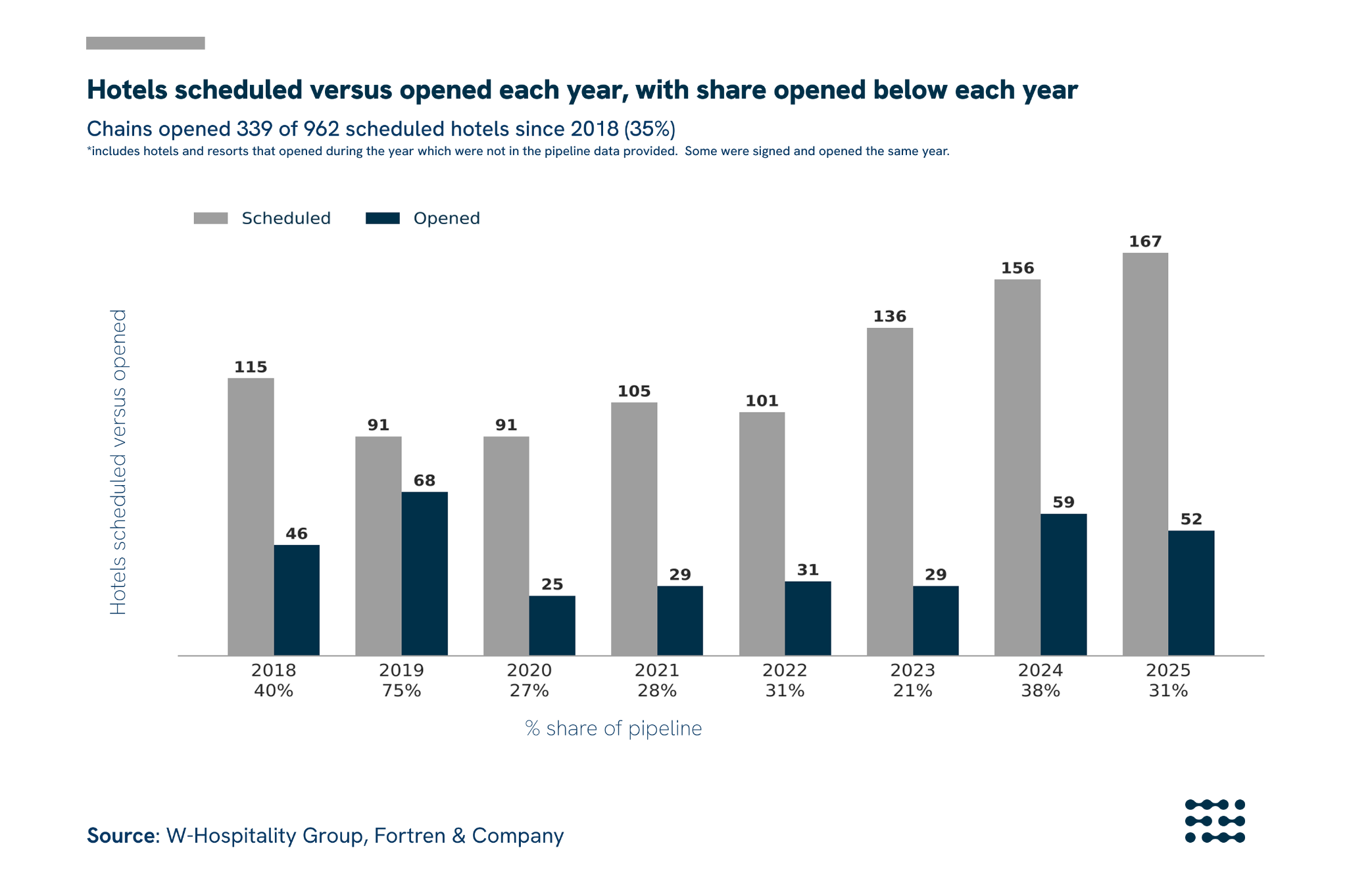
When you apply the 2025 actualisation rate of about one third to the 2026 schedule one can expect about 11,000 rooms to be realistically opened. Although about twenty per cent of the openings scheduled for 2026 and 2027 have not yet started construction.
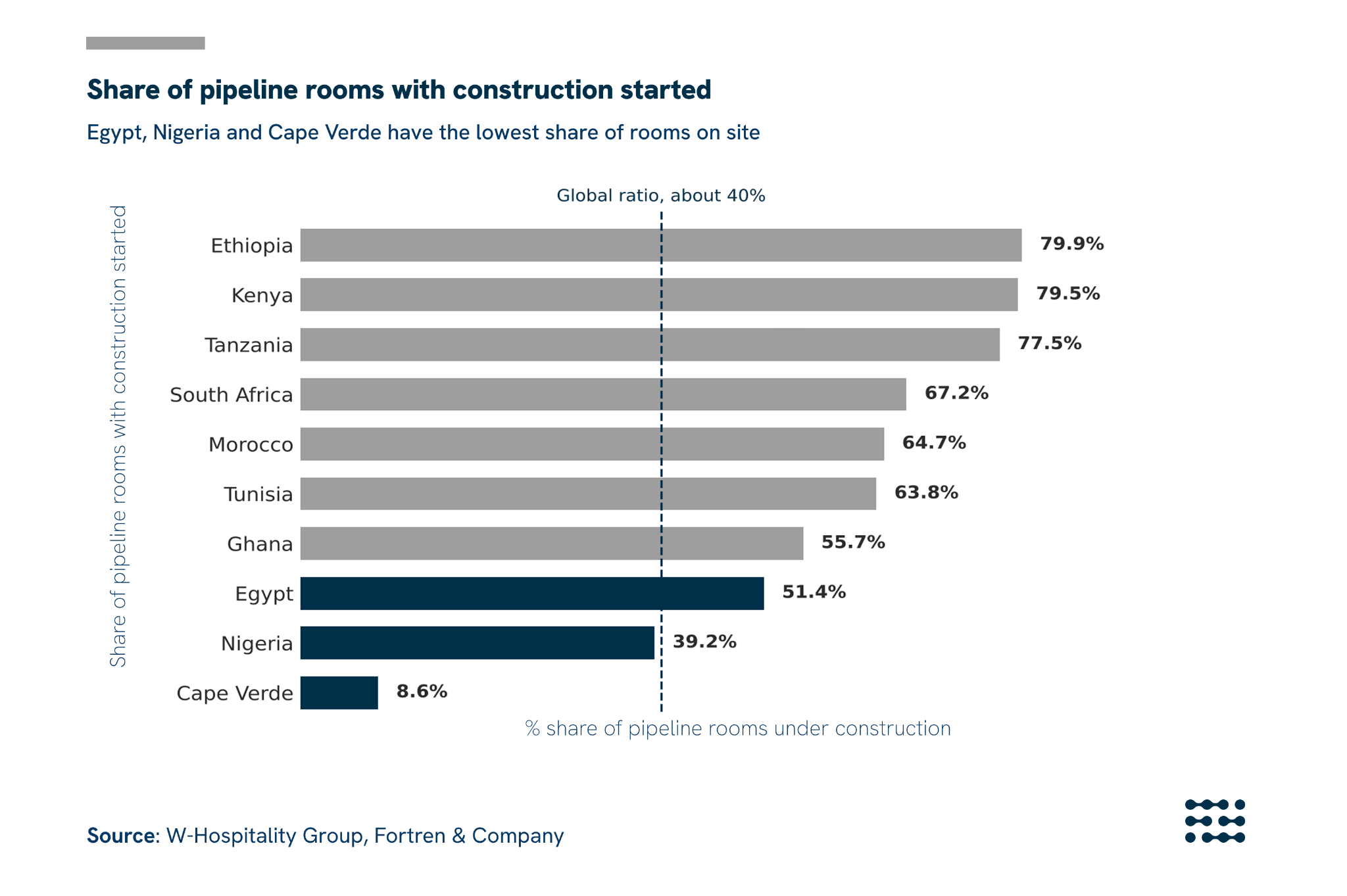
54% of pipeline rooms have started construction, more than the 40% global ratio.
Construction has started on 66,960 rooms, 55% of the North African pipeline and 53% of the sub-Saharan pipeline. Although the report defines “under construction” as work started on site, the count also includes projects that have stalled for several years. Ethiopia (79.9%), Kenya (79.5%) and Tanzania (77.5%) lead the top 10 countries. Radisson Hotel Group has 79.1% of its rooms on site and CityBlue 100%, against 23.9% for IHG, where half the deals were signed in the last three years. Rooms on site are a firmer guide to medium-term supply than rooms signed. In terms of what’s driving construction and openings, the evidence points to a mix of factors led by availability of capital and the local market, with deal age as a secondary factor. Brand strength explains little of this spread. Delivery tracks mirror access to local capital and the age of the deal, with East African markets such as Ethiopia, Kenya and Tanzania leading on rooms on site, and Nigeria at 39.2%, where Trevor notes there is no institutional equity but no debt that anybody can afford.
Again, chains do not fund the pipeline, and individual owners carry most of it.
In explaining who is funding the market, Trevor describes the main funders as high-net-worth individuals who often “borrow quite a lot more than meets the eye” and tend to build one hotel at a time. Institutional capital is concentrated in North Africa, where pension funds in Morocco invest at home and in Senegal. Spanish tour operators including Riu, Catalonia, Barceló and Meliá fund Zanzibar and Cape Verde resorts from family offices and balance sheets, and Heri adds investors from Mauritius to that group. Benin's hotels are mostly government funded.
Hotel funds buy existing hotels, which adds capital without adding rooms.
Kasada, a joint venture between Accor and Qatar, and Westmont have bought existing hotels and rebranded them. Heri sees both as an exit platform: a developer who builds in Dar es Salaam, Arusha, Dodoma or Kigali can sell to a buyer with the balance sheet to pay. According to Trevor, conversions supply one third to 40% of quarterly growth for the listed global chains, with fewer opportunities in Africa. Hotels there rarely change hands, and few independents seek a brand.
Can demand absorb the new supply?
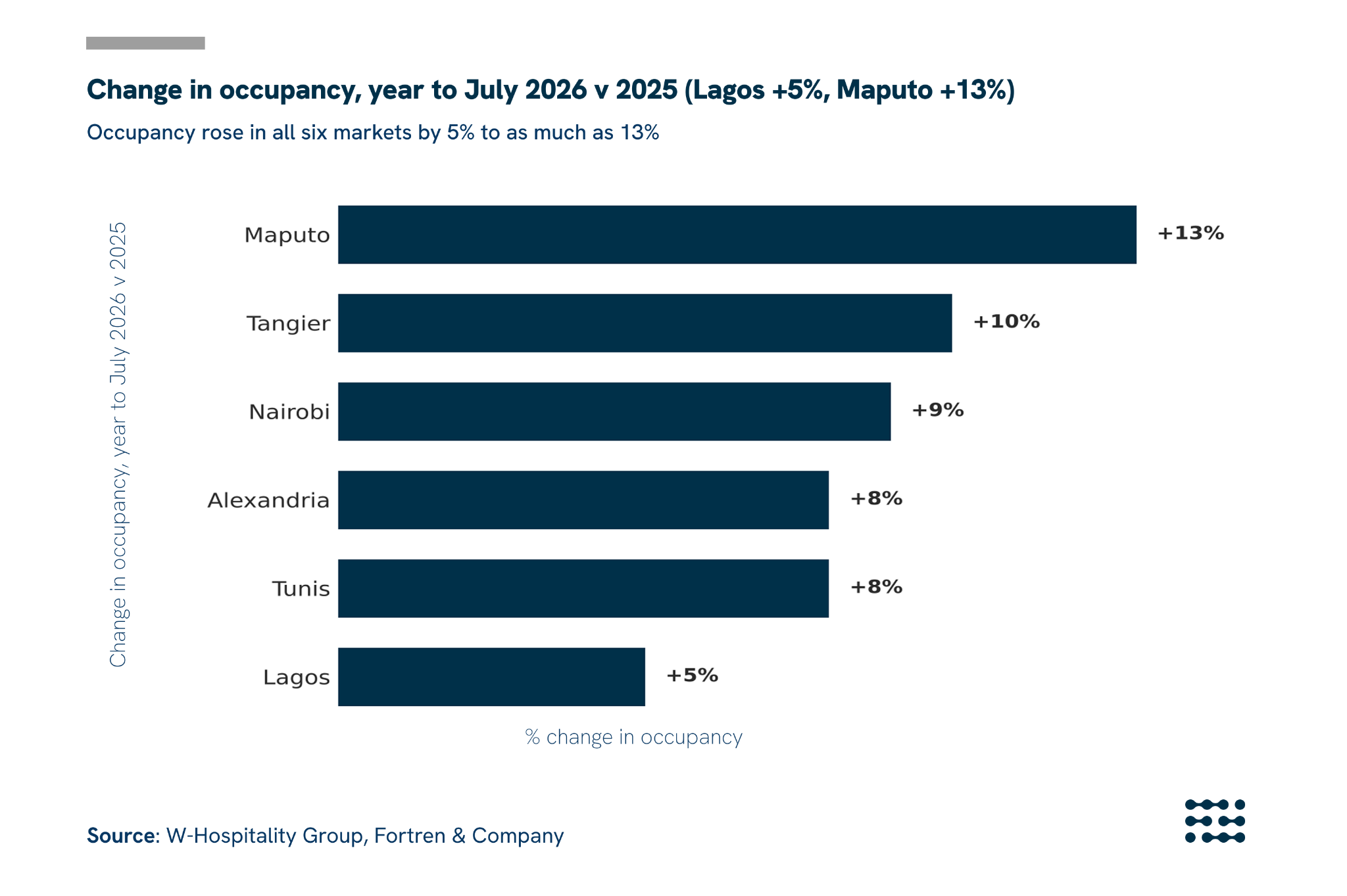
The answer to this question varies by city. Clearly, oversupply risk sits in a few cities where there is oversupply and limited tourism activity. In others like Zanzibar, where supply is paired with airlift, events and domestic business, and on current delivery rates absorption may not be an issue. Occupancy rose in every market in the past year and has been growing over the past decade (except for the pandemic year). Zanzibar, for instance, saw about 1 million tourists this year against 200,000 a decade ago, with Heri expecting 2 to 3 million within five years.
What does this mean for Africa's hospitality market?
Africa’s hospitality market will absorb the pipeline over a longer horizon than the contracts imply. From experience, signed rooms convert to openings slowly and selectively. Most of the current pipeline was signed in the last few years, and so much of it has yet to reach the build stage.
Access to capital decides which projects open. Although liquidity exists on the continent, with local banks profitable and lending, little of it reaches hospitality. Owners holding local-currency debt, patient equity and a credible exit route are more likely to convert contracts into rooms.
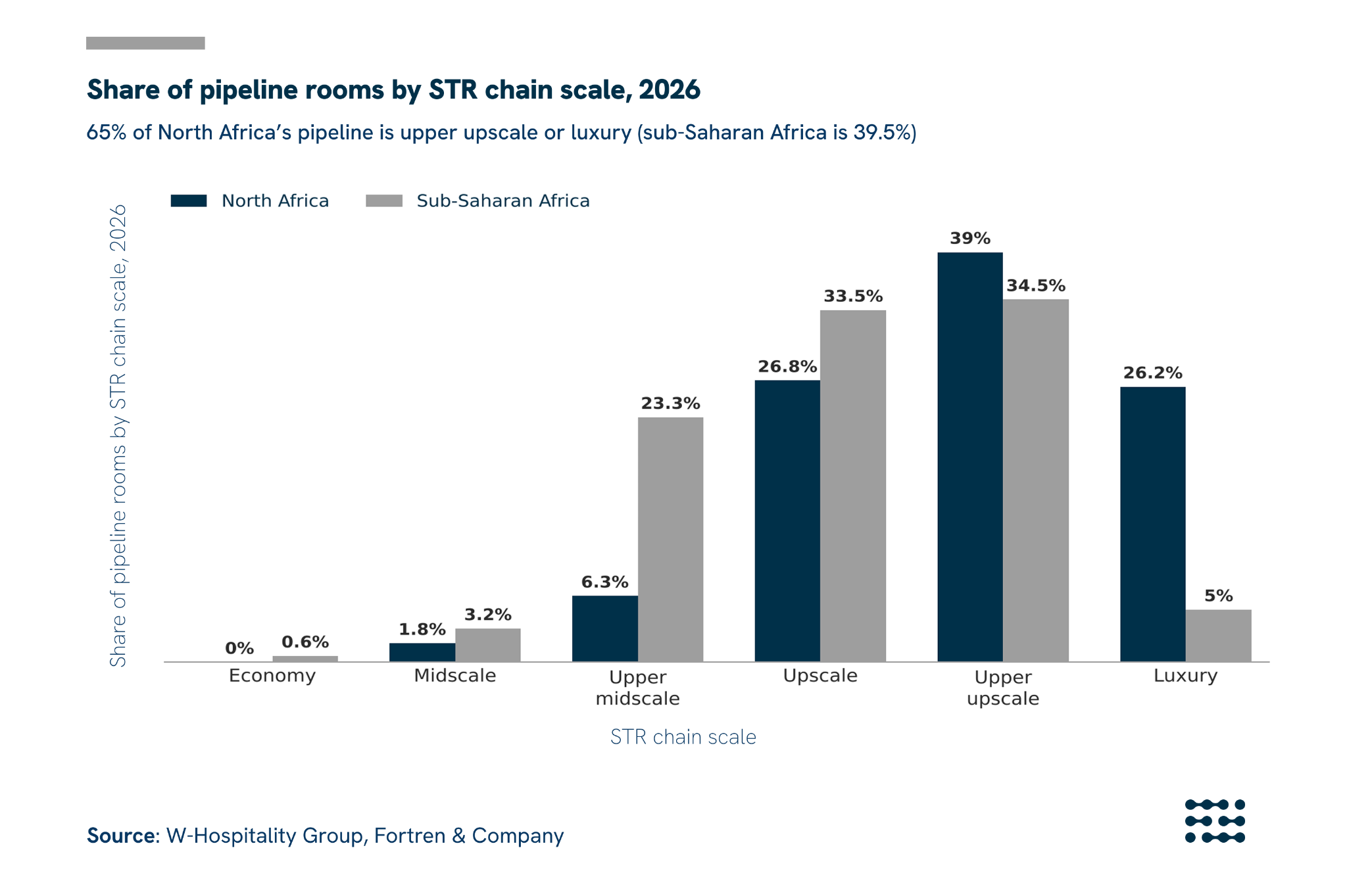
The pipeline shows where chains want to be, although delivery rests with the owners, lenders and governments who turn signed contracts into hotels. Developers and landowners must prove land, funding and a construction start, and the least-branded formats face the least competition. Operators and chains depend on openings for growth, so franchising, white-label partners and conversions are widening their route to rooms. Lenders and investors should underwrite against rooms on site and local delivery history, since hard-currency earnings and a credible exit route reduce funding risk. Governments that pair tourism policy with airlift attract signings, although air taxes work against traffic growth.
I would love to hear your feedback. Let us know if you think the market has room to absorb the pipeline or not. You can also join the conversation here on LinkedIn. If you need bespoke research on any asset real estate class, send us an email at advisory@fortrenandcompany.com, our team will be happy to support you!.